
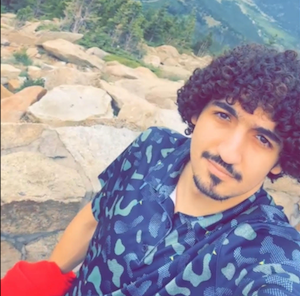
Suhail is a Ph.D. student at Rice University in Applied Physics and is affiliated with the Physics & Astronomy Department, specifically with Prof. Anthony Chan research group (Suhail's advisor). His primary research areas are computational and theoretical, and is interested in plasma in near-Earth space. Suhail is currently contributing to two main projects. The first primary project is the K2 computational model, developed by Prof. Chan and Dr. Scot Elkington (University of Colorado), along with contributions from many other institutions, e.g., University of Iowa, Air Force Research Laboratory (AFRL), and Boston University. The K2 aims to simulate relativistic charged particles in near-Earth space; specifically, in the radiation belts. Suhail's work also includes gathering satellite data, i.e., from NASA missions such as the Radiation Belt Storm Probes (RBSP), to feed, investigate, and compare the computational results.
Suhail's second primary project is to build a framework to test the quasilinear radial diffusion hypothesis through complementary computational and theoretical methods. The charged particles in Suhail's simulations are influenced by Earth's magnetic field (approximated as a centered tilted dipole field), and the electric and magnetic fields of the ultra low-frequency (ULF) waves, which can result in diffusive wave-particle interactions (WPIs) under certain conditions. The investigation of ULF-WPIs is divided into two main studies: single-mode and multimode wave interactions. Several analyses have been implemented to understand the nature of these WPIs. For example, Poincaré plots have been used to distinguish between regular and chaotic—or potentially stochastic—motion.