
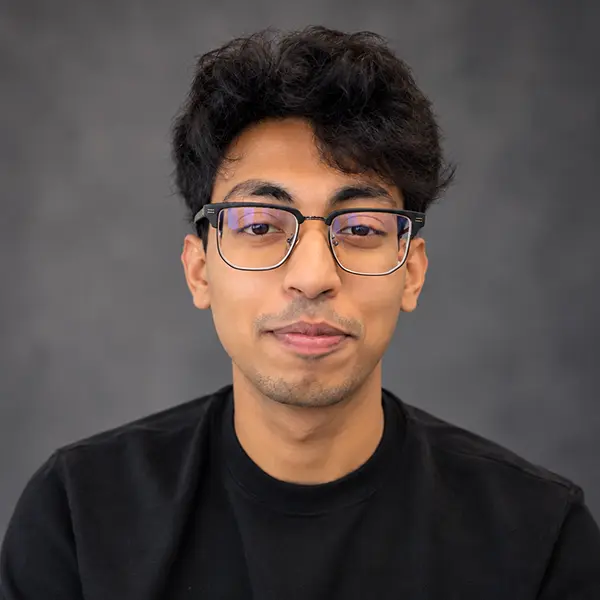
Iftekhar “Ifty” Ahmed is a researcher, tech entrepreneur, and computer science student at Rice University, working at the intersection of artificial intelligence, cybersecurity, and human-centered computing. His work spans assistive technology, AI-powered healthcare, and privacy-preserving systems, with a focus on translating complex technical ideas into practical solutions. At Rice, he is also involved with the Center for Engaged Research and Collaborative Learning (CERCL) and ACE@Rice.
Ahmed began developing technology in high school, founding Brailly to make education accessible to blind students. He developed an affordable Braille-based computer system to make academic materials accessible and designed a virtual keyboard to make digital interactions faster and easier for blind users. His work earned several national awards, recognition from MIT Solve and Bangladesh's Ministry of Education, and a nomination for the International Children’s Peace Prize alongside Greta Thunberg. At Rice, he co-founded Diagnos from his dorm room with the goal of making personalised healthcare accessible to everyone. Following its initial launch, Diagnos reached over 1,000 users and partnered with Rice Athletics to develop an in-house health tracking system.
His interests later expanded into AI vision and surveillance through his work on Lenze AI (https://lenze.ai/)), an MCP-based real-time visual perception system exploring multimodal scene understanding, temporal state tracking, and event-driven change detection to provide structured visual context for autonomous AI agents.
Ahmed’s current work focuses on secure real-time communication, cloud-isolated computing, computer vision, and multimedia forensics. He is currently building Qube (https://qube.so/), a secure meeting room designed to protect sensitive conversations and intellectual property from unauthorised AI tools and recording. His broader interests include trusted computing, secure collaboration systems, and making emerging technologies safer and more accessible.