
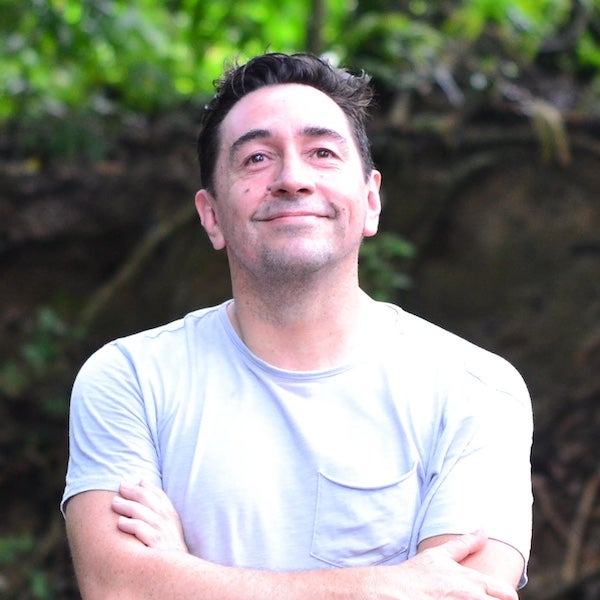
Santiago Amaya is Associate Professor of Philosophy. Before joining Rice, he was chair of Philosophy and associate professor at Universidad de los Andes in Bogotá, where he founded and co-directed the Moral judgment and Emotion lab. Santiago obtained his PhD in Philosophy-Neuroscience-Psychology at Washington University in St. Louis and was a Volkswagen Postdoctoral Fellow at the Berlin School of Mind and Brain.
RESEARCH INTERESTS
My research seeks to understand how cultural and social variation impacts the way in which human beings make significant life decisions, pursue worthwhile endeavors, and evaluate behavior. Studying the impact of culture and sociality on cognition is crucial for understanding how our minds operate in a world shaped by history, institutions, and politics, as well as specific everyday demands and human limitations.
A central part of my theoretical work has been on topics at the intersection of moral psychology and theories of agency: free will, intentional action, slips, etc. My papers, "Slips" (Noûs), "Two Kinds of Intentions" (Philosophical Studies), "Out of Habit" (Synthese) "Free Will is Vague" (Philosophical Issues) are good examples of my approach in these areas work. You can also take a look at my opinionated review of Vigilance in WIRES Cognitive Science.
In 2020, I founded the Moral Judgment and Emotion Lab with the goal of devising from the ground up methods to study how cultural variation impacts moral judgement. Our experimental work has been published by the British Journal for Psychology and the Journal of Psychology: General, among other venues. We are currently leading a team of more than 50 different labs, collecting moral experiences from around 3000 participants in more than 20 countries, representing 5 continents. This will be the largest ESM study done to date and will provide the largest existing open-access repository of moral experiences.
Some of my more applied work in the last few years has studied how discussions on the nature of responsibility and the “reactive attitudes” touch upon concrete situations of wrongdoing. I discussed some of this in “Negligence: its moral significance” and also in my paper Forgiveness as Emotional Distancing.” I am currently part of an interdisciplinary project that seeks to understand the relation between memory and forgiveness, in the light of the ideas defended on my paper on the topic. To this end, we have adapted a variety of well-established methods for studying auto-biographical traumatic memories in the lab to study, among others, rural populations in Colombia who have been victims during the Colombian armed conflict.
HONORS AND AWARDS
Santiago has been awarded grants by the Volkswagen Foundation, the John Templeton Foundation, the James S. McDonnell Foundation, the Psychological Science Accelerator, and the Open Society for Universities. He served as member of the advisory board of the Global Observatory for Academic Freedom. Currently Santiago serves as member of the steering committee of the Society for the Philosophy of Agency and is editor at Philosophia and Ergo.