
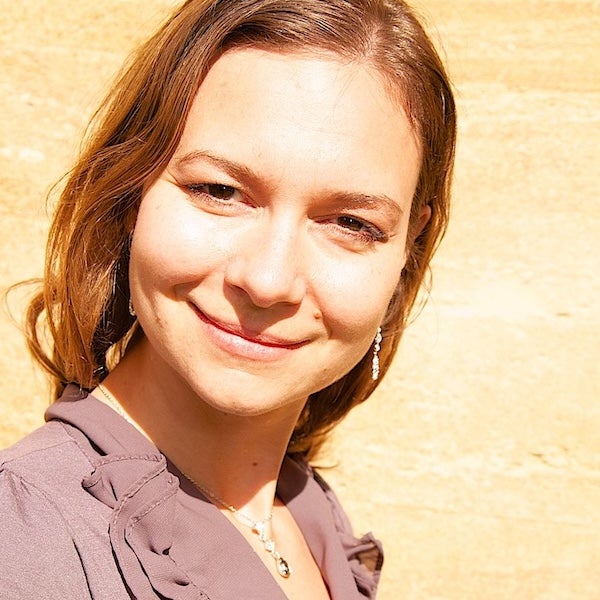
Nicole Sütterlin is an interdisciplinary scholar working at the intersections of literary studies, history of science, and ecocriticism. Before joining Rice’s MCLLC department in 2025, she taught modern German literature at Harvard University (2014-2025), the University of Basel, Switzerland (2007-2024), and Middlebury College, VT (2014).
Her research and teaching interests include German and European literature and culture from the 18th century to the present, with particular emphasis on trauma and memory studies; posthumanism; poetics and politics of the body; ecocriticism and environmental humanities; history of science; literature and social justice.
She is the author of Poetik der Wunde: Zur Entdeckung des Traumas in der Literatur der Romantik (Göttingen: Wallstein, 2019; Engl. "Poetics of the Wound: The Discovery of Trauma in German Romantic Literature"), the first-ever monograph on the emergence of psychological trauma in early 19th-century literature.
Her publications include articles on German classics such as Goethe and Kleist, contemporary writers such as Ulrike Draesner and Kim de l’Horizon, as well as French theorists such as Jacques Derrida and Roland Barthes. She has published in peer-reviewed journals such as Gegenwartsliteratur: A Contemporary German Yearbook, and in acclaimed textbooks such as Reclam's Zugänge zur Literaturtheorie: 17 Modellanalysen zu E.T.A. Hoffmann's 'Der Sandmann' and The Routledge Companion to Literature and Trauma (2020).
Her current book project, titled "Monstrous Microbes? Multispecies Bodies in the Posthuman Novel," explores how literature advances our understanding of the microbiome, a paradigm-changing concept in the life sciences that is crucially under-researched in literary studies. A fast-growing body of bioscientific research shows that microbial communities are declining rapidly in our bodies and environments – with dire consequences for human and planetary health. “Monstrous Microbes” examines how scarcely known contemporary Austrian, German, and Swiss writers creatively reimagine germs as symbionts, envisioning bodies, selves, and societies as multispecies endeavors.
SELECTED PUBLICATIONS
BOOK
Poetik der Wunde: Zur Entdeckung des Traumas in der Literatur der Romantik (Göttingen: Wallstein, 2019).
JOURNAL ARTICLES AND BOOK CHAPTERS
“The Art of Living Well with Worms: Interspecies Relationships in Olga Flor’s Posthuman Novel Ich in Gelb (2015).” Gegenwartsliteratur: A German Studies Yearbook 22 (2023). 289–312.
“History of Trauma Theory.” The Routledge Companion to Literature and Trauma. Ed. by Colin Davis and Hanna Meretoja (Abingdon: Taylor & Francis, 2020). 11–22.
“‘Asymptotische Annäherung’: Zur Poetik des Geotraumas bei Clemens Brentano und Reza Negarestani.” Athenäum: Jahrbuch der Friedrich-Schlegel-Gesellschaft 31 (2021). 161–214.
“Untod des Autors: Poststrukturalistisches Erzählen in der Literatur der 1990er Jahre.” Strukturalismus, heute: Brüche, Spuren, Kontinuitäten. Ed. By Leonhard Herrmann and Martin Endres (Stuttgart: J.B. Metzler, 2018). 187–207.
“Transgressions: On the (De-)Figuration of the Vampire in E. T. A. Hoffmann’s Vampyrism.” Transl. by Christopher R. Clason and Alexander Lambrow. E.T.A. Hoffmann: Transgressive Romanticism. Ed. by Christopher R. Clason (Edinburgh: Liverpool University Press, 2018). 112–130.
“E.T.A. Hoffmann and the Development of Trauma.” Essays in Romanticism 24:1 (2017). 83–104.
“Dekonstruktion: ‘Phantom unseres eigenen Ichs’ oder ‘verfluchter Doppeltgänger?’ Über die Unentscheidbarkeit von Hoffmanns Der Sandmann.” Zugänge zur Literaturtheorie: 17 Modellanalysen zu E.T.A. Hoffmanns Der Sandmann. Ed. by Oliver Jahraus (Stuttgart: Reclam, 2016). 84–100.
“Trauma-Poetik: Ulrike Draesners Sieben Sprünge vom Rand der Welt und die Körperpoetik der 1990er Jahre.” Gegenwartsliteratur: A German Studies Yearbook 15 (2016). 167–190.