
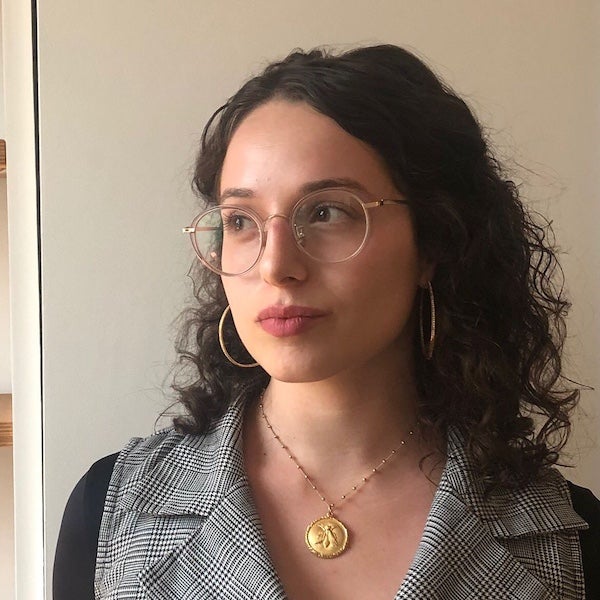
Julia Tomasson is a historian of premodern science, technology and mathematics. In both her research and teaching, Tomasson is interested in the surprising histories of concepts we take for granted—such as evidence, proof and reasonableness—and how ideas and practices of knowledge have changed across times and cultures. Tomasson holds an A.B from the University of Chicago in History, Philosophy, and Social Studies of Science and Medicine (HiPSS) and a M.A., M.Phil., and Ph.D. in History from Columbia University in New York.
Tomasson is currently working on her first book project, Polygons and Polyphony: Non- Euclidean Geometry and Premodern Geographies of Reason, which uses the case of geometry to explore how scholars working in different parts of the medieval world grappled with the limits of authority, space, and thought itself. Contrary to deeply rooted narratives about the stagnation of medieval science, Tomasson shows how scholars in both medieval Europe and the Islamicate world were interested not only in practical applications, but in theoretical problems of spherics and what it means to move “beyond Euclid.” Rather than imposing Greek or modern ideals of logic and mathematics, Tomasson traces the creative practices of reading, constructing, and critiquing mathematical proofs across different “cultures of proof.” Polygons and Polyphony tells not only a global history of mathematics that takes the interplay of different concepts of rationality seriously but also offers a new account of one of the most contested transmission histories in the history of science—the evolution and transfer of knowledge from Greek Antiquity to the “Golden Age” of Islam to the European “Scientific Revolution.”
Dr. Tomasson is happy to oversee independent studies, honors theses, and mentored research opportunities through the Mellon Mays Undergraduate Fellowship Program (MMUF) and Rice Undergraduate Scholars Program (RUSP). Tomasson also welcomes inquiries from graduate students (current and prospective) interested broadly in any of her methodological, temporal or geographic foci.
AY 2026-2027 courses:
FWIS 192: “The Scientific Revolution”: Knowing & Changing the World, 1450-1750 (Fall)
HIST 265: Cuneiform to Coding: A History of Information (Fall)
HIST 260: Early History of Science (Spring)
Spring 2026 courses:
HIST 260: Early History of Science