
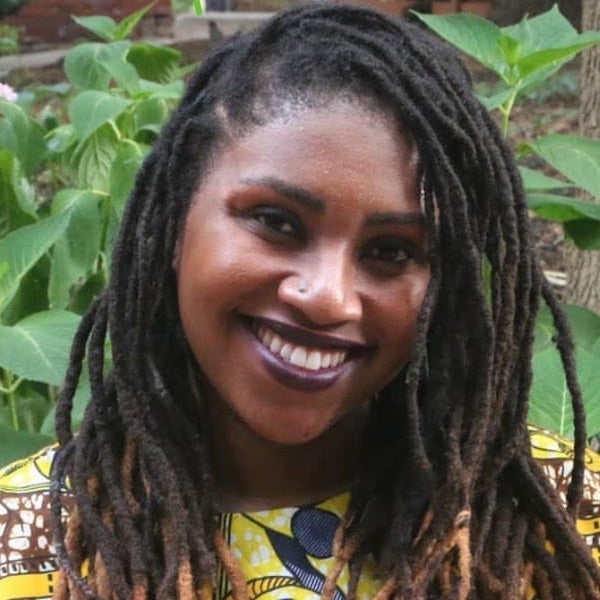
Eziaku Atuama Nwokocha is an Assistant Professor of African Diasporic Religious Thought and Traditions in the Department of Religion at Rice University. She previously held a position as an Assistant Professor of Africana Religions at the University of Miami and was a Presidential Postdoctoral Fellow at Princeton University. She obtained a Ph.D. with distinction in Africana studies from the University of Pennsylvania, a Master’s degree in Africana studies from the University of Pennsylvania, a Master’s degree in Theological studies from Harvard Divinity School, and a Bachelor’s degree in Black studies and Feminist studies from the University of California, Santa Barbara. Nwokocha was a Ford Predoctoral Fellow during her PhD and Ronald E McNair Scholar as an undergraduate.
Nwokocha is a scholar of Africana religions with expertise in the ethnographic study of Vodou in Haiti and the Haitian diaspora. Her research is grounded in gender and sexuality studies, visual and material culture and Africana Studies. She is an award-winning author of Vodou en Vogue: Fashioning Black Divinities in Haiti and the United States (University of North Carolina Press, 2023), an ethnographic study of fashion, spirit possession, and gender and sexuality in contemporary Haitian Vodou, exploring Black religious communities through their innovative ceremonial practices. The book is featured within the series Where Religion Lives. She was chosen as one of the 2025-2027 Young Scholars in American Religion at IUPUI’s Center for the Study of Religion & American Culture.
Nwokocha is currently working on her second book project which is tentatively entitled: “‘Tell My Spirit’: Black Queer Women in Haitian Vodou and U.S Hoodoo,” which investigates Black queer women’s interactions with Haitian Vodou divinities, their performance of ritual work, and their formation of religious communities in multiple locations including Houston, Texas; Montréal, Canada; Miami, Florida; Havana, Cuba; Paris, France; Brooklyn, New York, and Northern California. She pays particular attention to spiritual possession, which serves as a site for subversive ritual performances that contest dominant national and regional discourses on sexuality, gender, and race. Nwokocha has been featured in the Journal of Haitian Studies, Harvard Divinity Bulletin Magazine, Reading Religion, and Women Studies Quarterly.