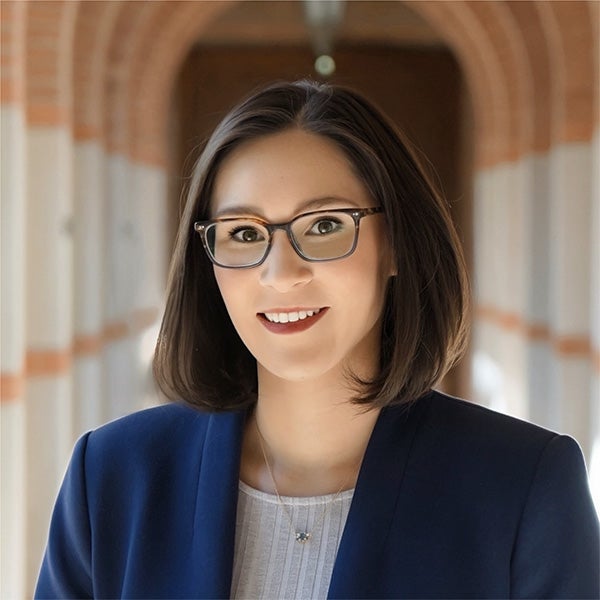
Alyssa (Allie) Sinclair
Assistant Professor, Psychological Sciences
Member, Institute of Health Resilience and Innovation
How can educators help students learn from their mistakes? What motivates behavior change to improve health and address climate change? How can we correct and counteract misinformation online? These real-world challenges are linked by common cognitive and neural mechanisms. The Sinclair Lab studies how people update their knowledge, beliefs, and behaviors.
Our brains are like time-machines: the same neural systems that enable us to vividly re-experience the past also allow us to make predictions and imagine the future. This cycle of prediction and updating helps us learn from error and adaptively change our behavior. The Sinclair Lab studies these mechanisms and applies insights by developing interventions that support learning and behavior change. Our team uses a combination of psychological experiments, brain imaging (fMRI), computational modeling, and large-scale online field studies to answer these questions and scale impactful interventions.
Research Areas
Cognitive Neuroscience, Learning and Memory, Belief Updating, Behavior Change, Affect, Information Consumption
Education
Ph.D. in Psychology & Neuroscience, Duke University, 2023
M.A. in Psychology & Neuroscience, Duke University, 2020
B.Sc. in Psychology (Research Specialist), University of Toronto, 2018
Societies & Organizations
Cognitive Neuroscience Society
Psychonomic Society
Society for Applied Research in Memory and Cognition
Society for Neuroscience
Society for Neuroeconomics
Honors & Awards
Joan Bossert Postdoctoral Research Fellowship (University of Pennsylvania)
Graduate Research Fellowship (National Science Foundation)
Postgraduate Scholarship (Natural Sciences and Engineering Research Council of Canada)
James. B. Duke Fellowship (Duke University)
Governor General’s Academic Medal (Government of Canada)